
Back up Coolify
An instance backup saves Coolify's own data, including your projects, resources, settings, and deployment history. It does not back up data stored inside your applications, databases, or volumes.
The Coolify team manages Coolify Cloud instance backups. You are still responsible for backing up the applications and databases deployed to your connected servers.
For a self-hosted instance, open Settings in the left sidebar, then select Backup.
If Coolify says instance backups are disabled, validate the server that runs Coolify:
- Select Go to Server Settings to Validate.
- On the server page, select Validate Server.
- After validation succeeds, open Settings > Backup again.
The first time you open Backup, select Configure Backup. Coolify then creates the backup configuration and turns on a daily backup schedule.
Before you back up
- Choose where you will keep a copy of the backup, such as another server or your computer. Do not keep the only copy on the Coolify server.
- Save the instance
APP_KEYas described below. Coolify uses this key to encrypt secrets stored in its database.
Choose a backup path
Use the dashboard while it is available. Use the terminal when the dashboard is unavailable or you need a backup that does not depend on the configured schedule.
Create a backup from the dashboard
Queue the backup
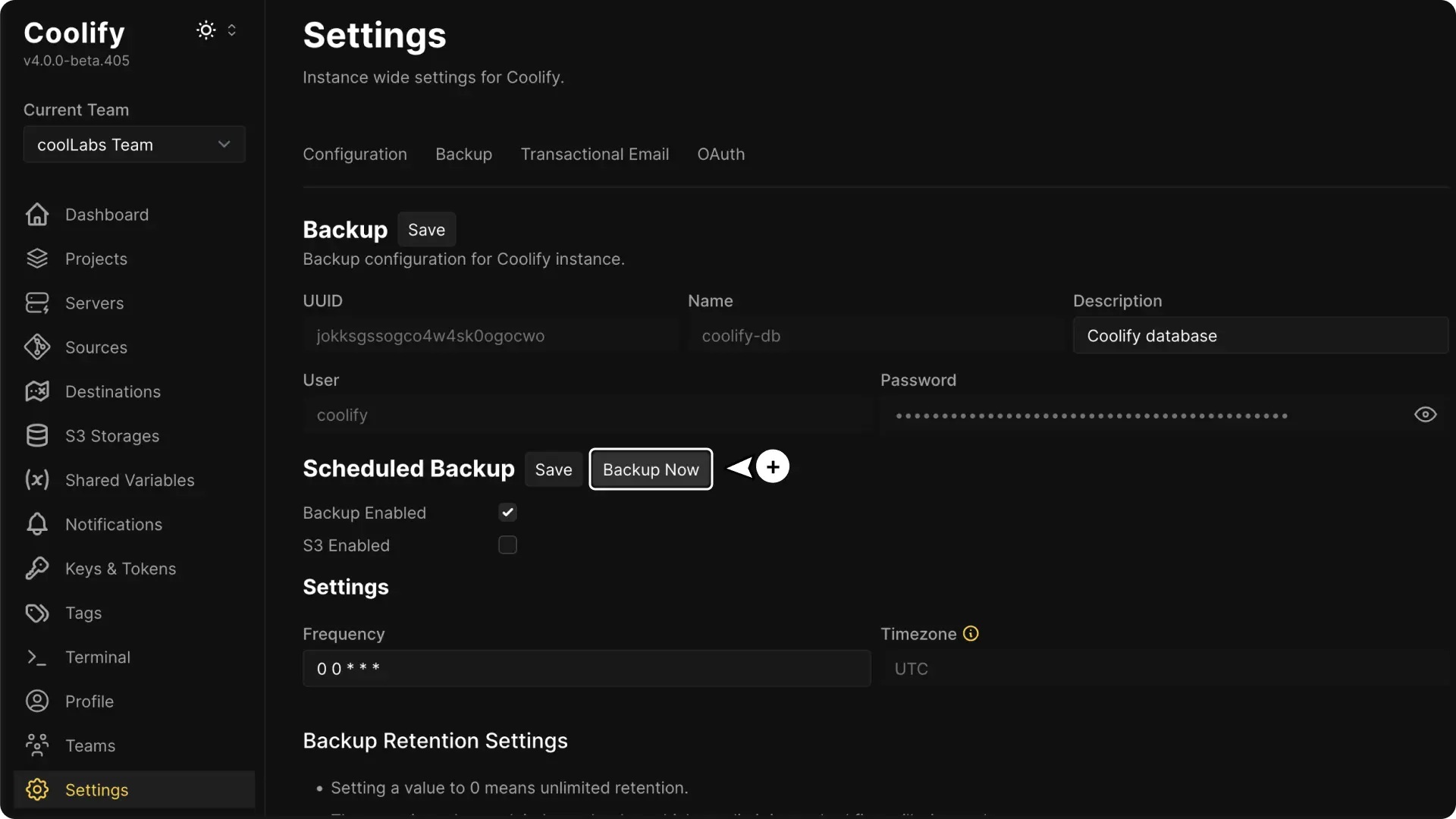
Under Scheduled Backup, select Backup Now.
Confirm the result
After you select Backup Now, a new entry appears under Executions. Its status changes from In Progress to Success when the backup is ready. If it changes to Failed, read the message shown in the entry.
Select Download while Local Storage is available to save a copy to your computer.
Save the instance encryption key
Coolify encrypts saved credentials and private keys before storing them in its database. The APP_KEY in /data/coolify/source/.env is the key used for that encryption. A database backup does not include this file.
Save the APP_KEY before you need to restore the instance. Treat it like a password and do not publish or share it.
On the server that hosts Coolify, display the key:
grep '^APP_KEY=' /data/coolify/source/.envCopy the complete APP_KEY=... line into a password manager or another secure place outside the Coolify server. S3 instance backups include only the database backup file, so you must save this key separately.
Configure recurring backups
The default Frequency is 0 0 * * *, which creates one backup each day at midnight in the instance timezone.
Set the schedule
Turn on Backup Enabled. Enter a valid cron expression in Frequency, or use every_minute, hourly, daily, weekly, monthly, or yearly.
Timezone is read-only and uses the instance timezone.
Set Timeout to the maximum backup runtime in seconds, then select Save. The accepted range is 60 to 36000; the default is 3600 seconds.
Configure local retention
Under Local Backup Retention, set any combination of these limits:
- Number of backups to keep accepts
0or a positive integer. - Days to keep backups accepts
0or a positive integer. - Maximum storage (GB) accepts
0or a positive number, including decimals.
A value of 0 makes that limit unlimited. The limits work independently, and Coolify removes the oldest successful backups when any configured limit is reached.
Add an S3 copy
Turn on S3 Enabled, select a validated S3 Storage target, then select Save. If no validated target exists, S3 Enabled remains unavailable.
When S3 is enabled, S3 Storage Retention provides the same three independent limits for S3 copies.
Turn on Disable Local Backup only when S3 should be the sole backup location. Coolify deletes the local file after a successful upload. If an S3 upload fails, Coolify keeps the local file and marks the execution Success (S3 Warning).
The dashboard cannot download a remote-only file. Download the backup from your S3 storage provider instead.
Verify and manage backups
Executions shows the status, database name, size, location, and storage availability for each backup.
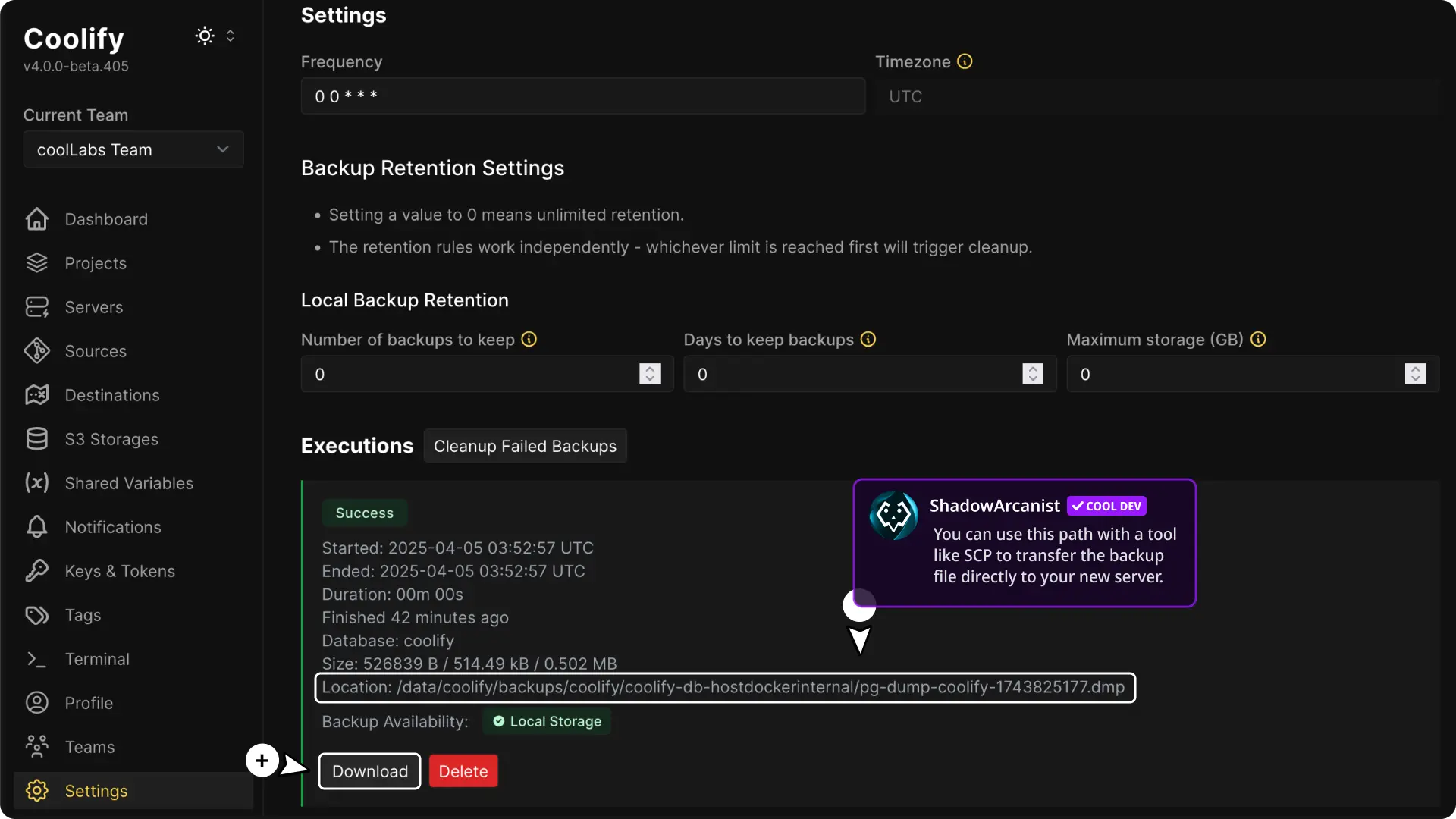
For a usable backup, confirm that the execution shows Success and that at least one storage location is available. Local instance backups are stored under /data/coolify/backups/coolify/coolify-db-<server-ip>/; use the exact Location shown in the execution to find a specific file.
The available actions depend on the execution:
- Download saves the local backup to your computer.
- Delete removes the local backup and can also remove its S3 copy when one exists.
- Cleanup Failed Backups removes failed execution records.
- Cleanup Deleted removes execution records already marked as deleted from local storage. It does not delete backup files.
Periodically check that you can access the copies stored on another server or your computer. Also confirm that you still have the saved APP_KEY. To test or perform recovery, follow Restore a Coolify instance.